It must be that time again. My Second Life Facebook feed is arguing about prices. And of course, I am adding my 2 cts, again.
This time, fatpacks and megapacks are the villains. The argument goes something like this: what once would have been sold as one reasonably priced fatpack is now divided into solids, prints, florals and separate pieces, only to be reunited in a megapack costing several thousand Lindens. Add an exclusive colour or two and apparently we are being “scammed.”
There are parts of that criticism I understand. There are pricing strategies in SL fashion that annoy me too. But before we decide that creators have suddenly become greedy and everything used to be wonderfully affordable, it is worth checking our memory against what we actually know.
Second Life fashion and avatar components were never uniformly cheap. Nor can I find evidence for the idea that there was once a standard price for a “complete fatpack.” Prices varied enormously between creators, just as they do today. We had freebies, dollarbies and inexpensive fashion, but we also had premium hair, shoes, skins and clothing that could make a serious dent in your Linden balance.
Skins offer an interesting historical reality check. Contemporary reporting from 2007 shows premium individual skins selling for L$750 to L$1,350, with one three skin pack priced at L$2,700. Today, individual head skins commonly sit in roughly the same broad Linden range, although modern products are structured differently, often around separate head and body skins and established tone systems. It is therefore not a clean like for like comparison, but it certainly does not support the idea that spending hundreds or even thousands of Lindens on premium avatar appearance is a recent development
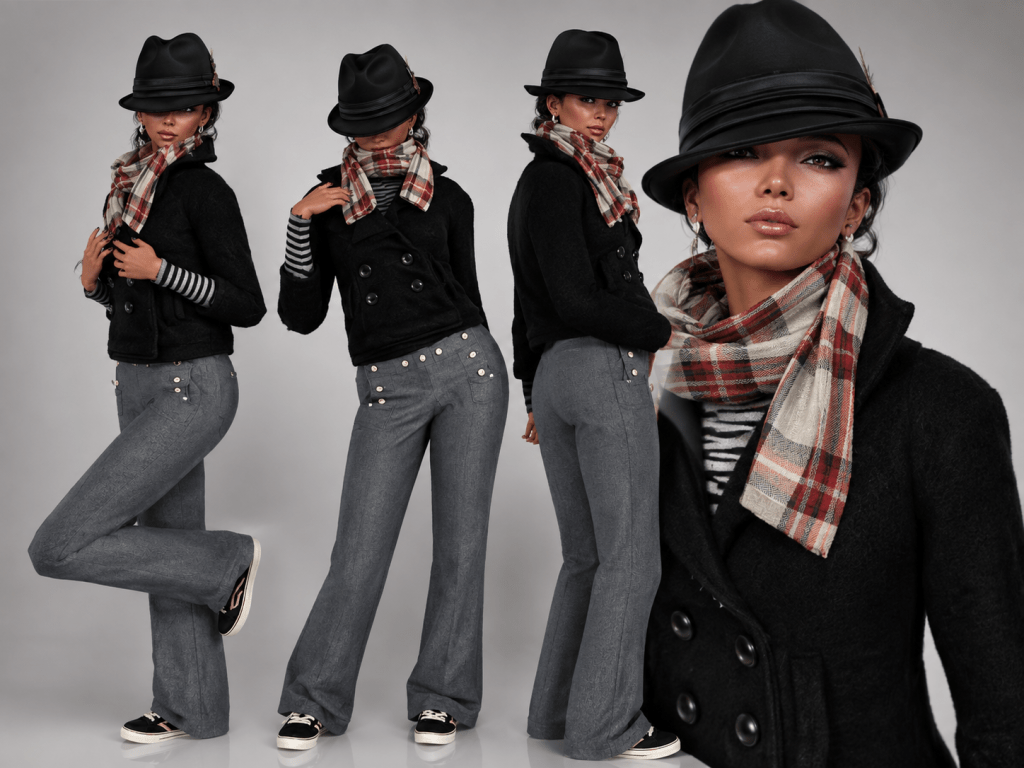
Fashion itself was also a very different product. Before mesh went gridwide in August 2011, we dressed ourselves in system layers, prims and sculpties. Good creators could do extraordinary things with them. Hair was constructed from individual prims and sculpted pieces. Shoes could be astonishingly intricate. Jackets acquired separate collars, cuffs and belts, while skirts required enough attached geometry to make sitting down something of an adventure.
I don’t think it is fair to say that those creators worked less than today’s creators. They worked differently. Modern fashion moved much of the construction into external 3D software and added modelling, UV mapping, rigging, weighting and fitting to the process. The proliferation of mesh bodies added another consideration because a creator choosing to support several bodies has to make sure the garment works properly on each of them.
Meanwhile, we have become rather demanding shoppers. We want good modelling and texturing, multiple body fits, materials, HUDs, dozens of colours, metal choices, demos and products that behave properly when our AO decides to fling an arm through our ribcage. We expect a much more technically sophisticated product than we bought twenty years ago.
That doesn’t mean every price attached to it is reasonable.
This is where I think the criticism of megapacks becomes more interesting. If solids, prints and patterns are separated into several fatpacks and then combined into a megapack, the creator can advertise a substantial saving compared with buying everything separately. Mathematically that may be perfectly true. Whether it represents value to you is another question.
If I want one black sweater, 60 additional colours do not make the product 60 times more valuable to me. If I love the sweater and regularly use twenty of those colours, the calculation changes. If the megapack contains several coordinating pieces I would otherwise have bought individually, several thousand Lindens may be excellent value. The size of the folder does not determine the value of its contents to the person buying it.
Exclusive megapack colours are another legitimate subject for criticism. Putting a particularly desirable colour or print exclusively into the largest pack encourages customers to spend more. That is quite obviously the point. You are allowed to find that irritating, and you are allowed to decide that you won’t support it.
I would simply stop calling it a scam.
If the vendor clearly shows what each package contains and what each package costs, you are looking at a pricing strategy. You may think it is manipulative. You may think it is terrible value. You may decide that L$3,999 for a megapack has officially entered comedy territory. Unless something has been misrepresented, however, nobody has deceived you.

Creators are equally entitled to point out that the product did not materialise out of nowhere. Digital goods have almost no reproduction cost, but they do have production costs. Once a dress exists, selling another copy costs almost nothing. Creating the dress in the first place required somebody’s time, equipment and skill, and the creator has no idea beforehand whether the finished product will sell fifty copies or five thousand.
That is the part that disappears when we say virtual fashion should be cheap because it is “only pixels.” We are not paying for virtual cotton. We are paying for the work required to create the thing we want to wear.
There is another influence on our perception of price that deserves more attention: weekend sales. SL shoppers now have access to a continuous stream of fashion at L$50, L$60, L$75 and L$100. Good fashion, too. Shop enough weekend sales and those numbers inevitably become reference points. A normal L$300 release starts looking expensive when you have trained yourself to wait until Saturday.
That means Second Life fashion can simultaneously feel cheaper and more expensive than it once did. At one end, there is an extraordinary amount of inexpensive sale merchandise. At the other, elaborate fatpacks and megapacks have created a premium tier where a single click can cost several thousand Lindens. Those things are not contradictory.
And perhaps that is why the current argument becomes so heated. We keep trying to establish one objectively “fair” price when no such number exists.
Creators need to decide what compensates them adequately for making fashion. Shoppers need to decide what that fashion is worth to them. Neither side gets to make the other calculation. The fact that somebody spent thirty hours making a dress does not oblige me to buy it, and the fact that I cannot or will not spend L$3,000 does not oblige its creator to sell it to me for L$300.
Where I think shoppers have considerable power is in deciding which pricing practices we reward. Don’t like exclusive megapack colours? Don’t buy the megapack to get them. Think a fatpack offers poor value? Buy a single colour or walk away. Think a creator consistently produces excellent work at prices you consider reasonable? Buy it.
That communicates considerably more than another Facebook argument.
Second Life fashion has changed enormously since we were adjusting prim cuffs around our ankles, but there is little evidence for a lost age when premium virtual goods were universally cheap. There is equally little reason to pretend that every modern megapack represents wonderful value simply because a creator has put a large number of options into it.
Creators are entitled to fair compensation for their work. Customers are entitled to expect fair value for their money. The interesting part has always been where those two meet. And if they don’t meet, there is still a remarkably effective solution available to every Second Life shopper.
TP out!
XO, Graz
PS: yes, I have used AI to create a modern rendition of old blog pics from 2009! click the images to see the originals!


Leave a comment